
2026 Sustainability Outlook
Sustainability at the Intersection of Finance, Technology, and Geopolitics
In the first episode of Greenhub TV of 2026, the Greenhub team shared their outlook for the year, providing a snapshot of how sustainability topics and policies are evolving and focusing on a select few topics that are likely to (re)shape the landscape in the coming months.
Sustainability in Transformation
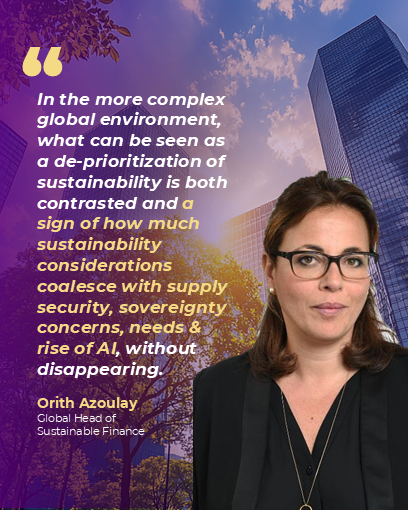
The start of 2026 has already been defined by a complex and demanding global environment marked by geopolitical tensions, industrial shifts, and rapid technological advancements. In this context, sustainability remains a central reference point, albeit in an evolving role.
Rather than a uniform de-prioritization, sustainability is being transformed, becoming interwoven with supply security, sovereignty, and industrial competitiveness. Transition momentum identified in previous years persists, despite political backlash, the expansion of defense spending, and the rapid growth in energy demand notably linked to artificial intelligence.
The analytical oversights established in 2023 remain relevant for understanding these dynamics. Sustainability considerations are not dwarfed by competing priorities; they are being reframed to align with resilience, strategic autonomy, and long-term value creation. The themes addressed throughout 2025 – transition planning, adaptation, transition finance, ESG backlash, and supply chain resilience – lay the foundation for developments expected in 2026.
The Sustainable Bond Market: A More Mature Phase
Sustainable bond markets demonstrated resilience in 2025, reflecting increased maturity among both issuers and investors. While differences remain across regions and asset classes, overall dynamics point to stabilization rather than contraction.
In 2026, sustainable bond issuance is expected to exceed USD 1 trillion, fueled by higher redemptions, continued investment in the energy transition aligned with 2030 targets, and rising energy demand associated with economy wide-electrification and AI-related infrastructure needs.
Regional disparities, however, remain. Europe is expected to see higher volumes,
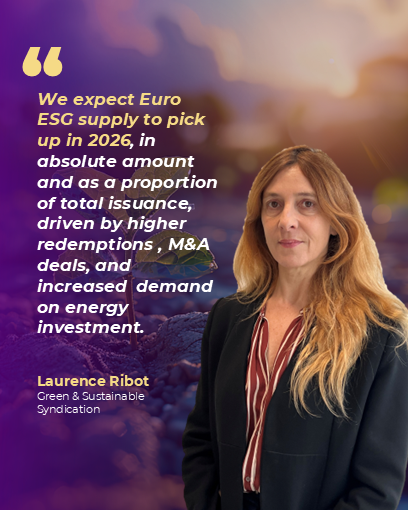
with green bonds returning to approximately 20% of total issuance, in line 2023 and 2024 levels. China is emerging as a key transition finance hub, while issuance dynamics in the United States remain more mixed.
From a segment perspective, social bond issuance – particularly by agencies – is expected to increase. EU Green Bonds are also set to expand further in 2026, building on strong issuance momentum in 2025, when close to EUR 222 billion was issued across corporate and financial institutions.
Frameworks, Instruments, and Investor Positioning
In 2025, issuance activity was characterized by accelerated updates to sustainability frameworks. Sovereign issuers such as France and Italy updated their frameworks in 2025, and Germany just released its updated Framework in Jan 2026. A reinforced integration of the EU taxonomy emerged as a defining feature, extending beyond EU Green Bonds and into broader regulatory discussions, including those linked to the Omnibus reform.
Looking ahead, attention is focused on several developments: the potential scaling of climate transition bonds following guidance released in 2025, a continued decline in Sustainability-Linked Bond issuance, and the gradual emergence of nature-related green bonds supported by ICMA guidance and increasing investor interest.
Sustainable Loans: Pragmatism and Financial Materiality
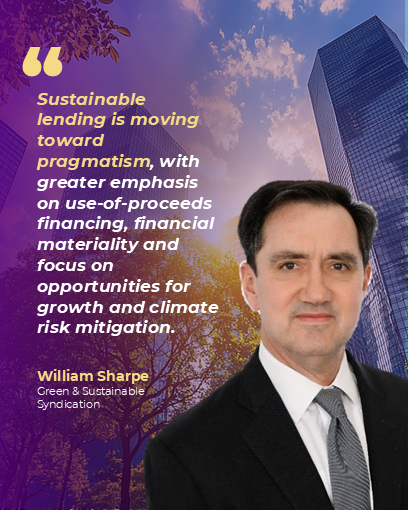
Sustainable loan markets continue to evolve toward a more pragmatic and financially grounded approach. Use-of-proceeds financing gained further prominence, while sustainability-linked loans declined as borrowers and lenders reassessed their effectiveness.
In 2025, global green loan issuance increased by 36%, reaching USD 225 billion, while sustainability-linked loan volumes declined by 17%. Growth in Europe was driven by large energy and infrastructure projects supported by export credit agencies and development banks. In the United States, volumes remained stable, supported by continued investment in data centers and
renewable energy. In Asia-Pacific, green loan issuance surpassed sustainability-linked loans for the first time, including significant real estate financing.
Among corporate borrowers, some large issuers questioned the incremental value of sustainability-linked loans where sustainability strategies and targets were already well established. Market scrutiny increasingly focused on the robustness of sustainability frameworks and borrower readiness, with ESG-linked pricing mechanisms sometimes postponed when performance indicators were not sufficiently mature.
Private Credit and the 2026 Lending Outlook
Sustainable private debt remains a niche segment but continues to expand rapidly in both infrastructure and corporate lending. In 2026, sustainable lending activity is expected to be supported by continued growth in green use-of-proceeds instruments, European policies promoting clean energy and strategic autonomy, sustained investment in data centers, and strong investor appetite for sustainable private credit driven by attractive yields and opportunities in infrastructure and climate technology.
Sustainability-related data is increasingly expected to be collected on a transactional basisl rather than primarily through regulatory reporting, reflecting ongoing regulatory streamlining in Europe.
AI Infrastructure and Environmental Impacts
Investment in artificial intelligence and data infrastructure has accelerated significantly in recent years. Global data center investment nearly doubled between 2022 and 2024, reaching approximately USD 500 billion, with estimates rising to USD 620 billion in 2026[1].
In 2024, data centers accounted for 1.5% of global electricity consumption, with consumption increasing at 12% per year since 2017 – four times faster than overall electricity demand. Electricity consumption is projected to triple from 130 TWh in 2023 to 1,500 TWh by 2030[2].
While significant developments are taking place, geographic concentration has created physical constraints.
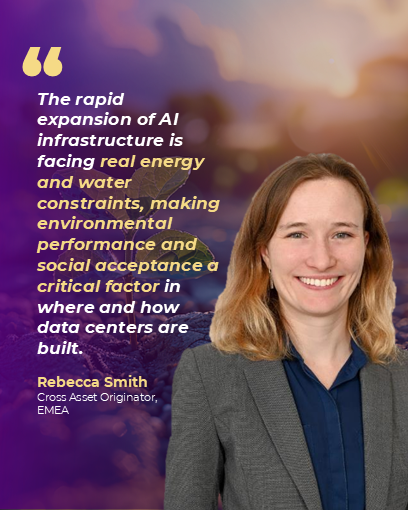
In Ireland, for example, data centers account for 20% of national electricity consumption, leading to restrictions on new developments. While there is development of renewable energy to meet this increasing demand, it does not cover all the power needs. As a result, greenhouse gas emissions from data centers are projected to increase by approximately 9% per year[3].
Water use too represents a parallel challenge. AI-related water withdrawal is estimated at 4.2 to 6.6 billion cubic meters by 2027, equivalent to four times Denmark’s annual water consumption. In some US locations, data centers consume up to 25% of local water supply. This, as well as concentration of power consumption among other factors, contributes to social opposition and resulting in USD 64 billion worth of projects being delayed or blocked.
Finally land degradation relating to mining activities upstream the value chain of AI is also significant, as metals are necessary for the production of Graphic Processing Units (GPUs), the computing power of AI. Their number is expected to be multiplied by 5 in ten years between 2025 and 2035[4]. These GPUs are mostly made of metals, about 50% of copper, but also more than 20 other sorts of metals, including gold and rare earth metals. We thus have an increase in the demand for metals, and their extraction, with all the related environmental consequences.
AI and Workforce Implications
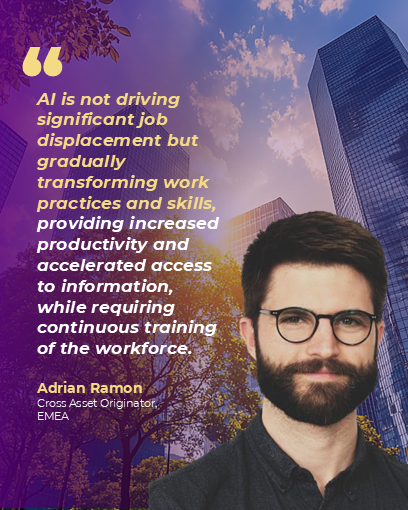
The deployment of artificial intelligence has not resulted in large-scale job displacement. A study by the International Labour Organization (ILO) indicates that 10–13% of jobs are affected to some degree by AI automation and augmentation, while actual displacement is limited to 2–3%, primarily among what are considered to be lower-skilled clerical roles, such as data entry and call center operations.
Another study by the MIT, notably analysing the disruption effect of AI in various industries, actually shows that despite high-profile investment, industry-level transformation remains limited, maybe with
the exception of Media & Telecom and professional services industry. GenAI has been embedded in admin support, content creation, and analytics use cases, but few industries show the deep structural shifts associated with past general-purpose technologies (like the internet) such as the emergence of new market leaders, disrupted business models, or measurable changes in customer behavior or product delivery.
Another interesting finding by this MIT study is that while most Generic LLM chatbots or consumer-grade AI tools like ChatGPT or Copilot show high pilot-to-implementation rates (at more than 80%) because they are familiar and easy to use, only 5% of custom enterprise AI tools reach production. In other word 95% of pilot fail. They fail mainly due to shortcomings in workflow integration, lack of contextual learning from current AI systems. Those models do not retain feedback, adapt to context or improve overtime. The core barrier to scaling is not infrastructure, regulation or talent, it is learning ability of AI.
However AI is viewed by most executives as a competitive advantage for workflow optimization, and AI literacy is increasingly viewed as a recruiting requirement, reinforcing the importance of workforce training and adaptability in a context of AI deployment.
The next wave of AI, namely Agentic AI, is expected to bring further disruption to the labor market as it seeks to address the learning gap of current GenAI systems by maintaining persistent memory, learn from interactions and autonomously orchestrate complex workflows.
Responsible AI and Sustainability Use Cases
Green data centers are defined by their ability to mitigate negative impacts rather than generate direct environmental benefits. Key levers include energy efficiency, renewable energy sourcing, and reduced water consumption.
Responsible AI deployment requires the definition of carbon reference trajectories and budget, assessment of functional scope, and evaluation of the energy-carbon cost in complement to economic costs. Optimization of AI models (smaller size, lower computing demand) and careful definition of deployment scope are central to limiting their environmental impacts.
At the same time, AI systems can support sustainability objectives through processing of large amount of data, optimization of solutions and solving under constraints, predictive modeling, and scenario simulation. Applications include biodiversity monitoring, agricultural optimization, renewable energy integration, grid balancing and efficiency, and the integration of AI in digital twins to test infrastructure resilience under various conditions, including extreme weather events, and provide for predictive maintenance.
Geospatial Data and Asset-Level Insight
Geospatial data enables the linkage of corporate assets to precise geographic locations and physical characteristics. These datasets support asset-level analysis across sectors, including data centers, logistics, utilities, and office buildings. While challenges remain around coverage completeness, asset criticality, and standardization, geolocation accuracy is generally high.
When combined with environmental and climate layers, geospatial data enables identification of exposure to water stress, climate-related physical risks, biodiversity sensitivity, and nature degradation. Real-time monitoring allows observation of land-use change, degradation, or restoration over time.
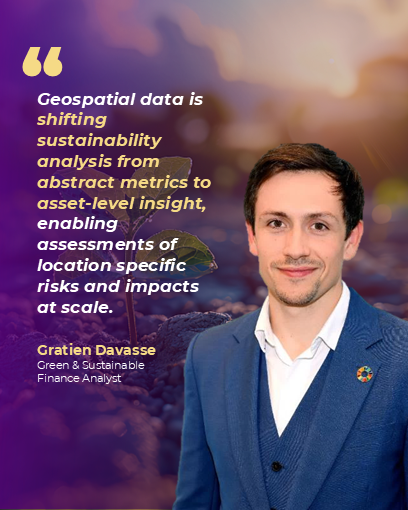
Geospatial data also supports climate and nature stress testing, enabling assessment of production disruption and credit risk under current and future climate scenarios. Effective risk assessment, however, depends on better disclosure of asset-level mitigation measures by corporates.
Translating Intelligence into Action

The value of geospatial intelligence lies in its ability to inform decisions. When integrated into financial and sustainability processes, asset-location data enables institutions to prioritize risk, guide capital allocation and strengthen operational resilience.
For investors, this kind of intelligence helps differentiate between systemic exposure and asset-specific vulnerabilities, supporting more accurate risk pricing. For corporates, it informs site selection, and mitigation planning in response to climate and nature-related pressures, among others.
By anchoring sustainability strategies in physical reality, geospatial intelligence supports more targeted, measurable and
credible approaches to risk management and impact delivery.
Sustainability, Sovereignty, and Geopolitics
Sustainability and geopolitics are increasingly being seen as interdependent. Climate change acts as a multiplier of geopolitical instability as it’s impacts lead to resource scarcity, migration, and economic disruption. At the same time, sustainability is being reframed within a more realist geopolitical context.
Competition over resources lies at the core of geopolitics, while sustainability focuses on their management. These dynamics are converging as countries integrate sustainability into industrial, trade, and sovereignty strategies and policies. Europe increasingly uses sustainability standards as market access tools, supported by policies
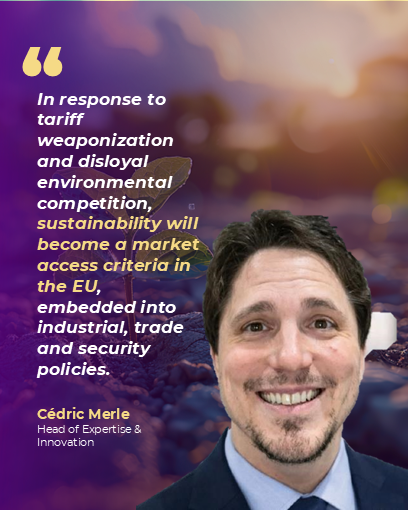
such as the Net Zero Industry Act, the Critical Raw Materials Act, and product-specific requirements including battery passports and domestic manufacturing requirements.
Rising defense spending has not excluded sustainability considerations. Throughout 2025, investors and issuers integrated transparency, governance, and impact assessment practices into defense-related financing. Frameworks developed within sustainable finance have been adapted to traditionally sensitive sectors, reflecting a broader shift away from binary trade-offs between competitiveness, security, and sustainability.
Sovereignty is increasingly functioning as a principle through which sustainability objectives are being reinterpreted and implemented. Reducing external dependencies, rebuilding domestic capabilities and shortening supply chains are now
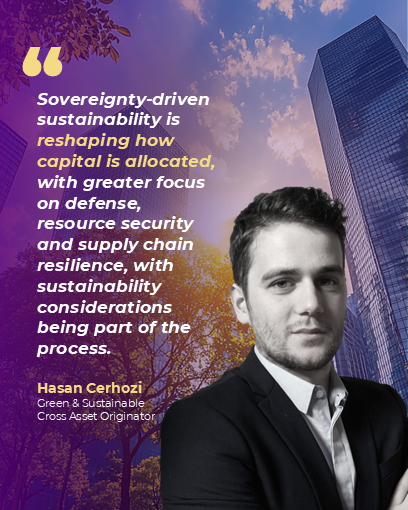
more than ever seen as strategic and sustainability priorities. In this context, sustainability is no longer seen as a constraint to economic of security objectives, but as a tool to manage exposure to geopolitical risks, resource scarcity and supply disruptions. European policy instruments demonstrate this shift by embedding environmental and climate requirements into market access conditions, domestic production rules and public procurement. This approach reflects a broader transition away from a purely sustainability agenda, towards one grounded in strategic autonomy, competitiveness and long term resilience.
A Pragmatic Transition Phase
In 2026, sustainability will operate within a more pragmatic and geopolitically grounded framework. While backlash and regional divergence persist, sustainability continues to evolve rather than retreat, aligning more closely with resilience, sovereignty, and long-term economic competitiveness.
Watch the Replay - Green Hub TV Episode 7

Dont miss our previous episodes:
[1] Source : Morgan Stanley
[2] Source : The Shift Project
[3] Source : The Shift Project
[4] Source: IdTechEx
