International Flows: Where do we Stand?
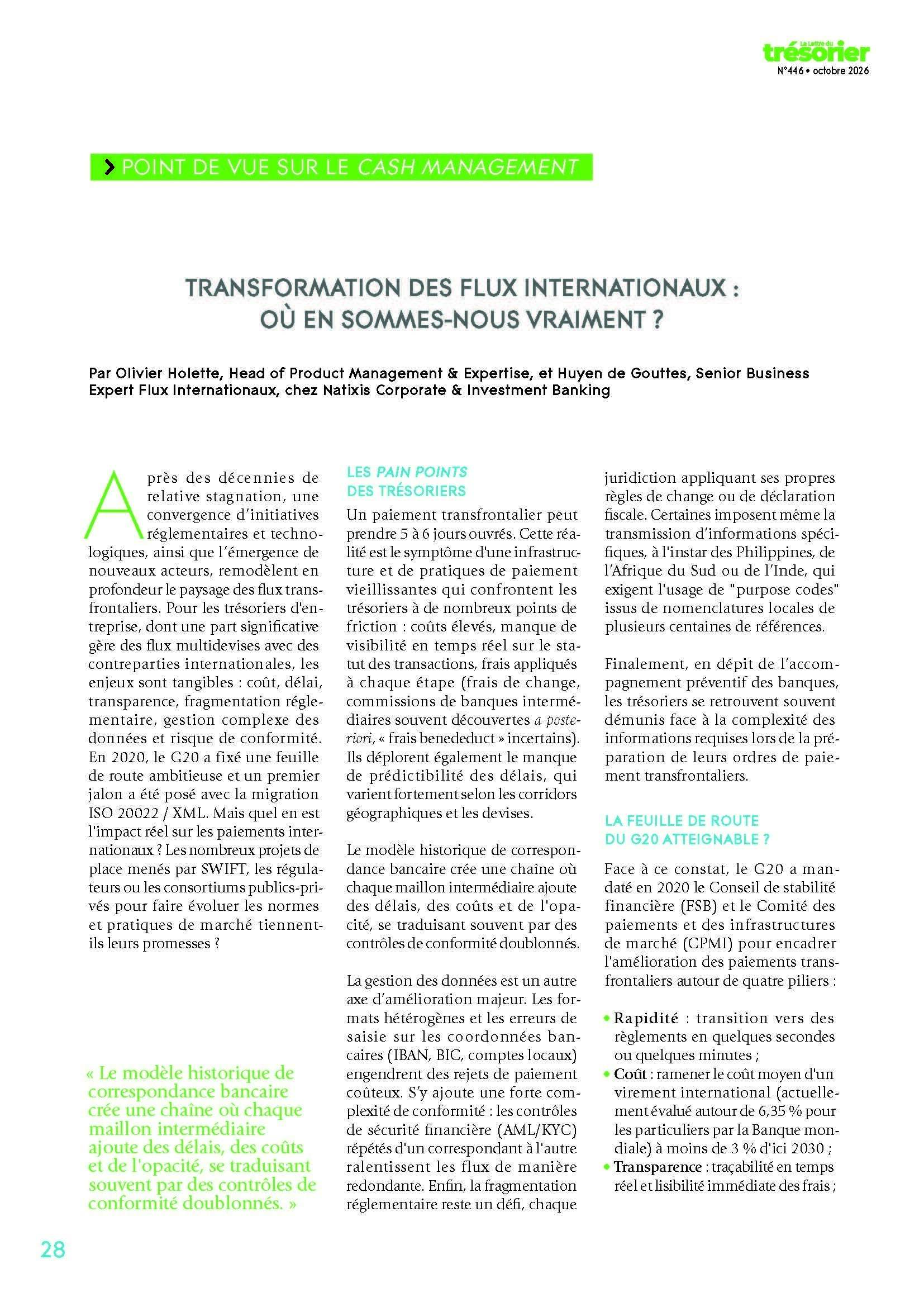
After decades of relative stagnation, a convergence of regulatory and technological initiatives, alongside the emergence of new players, is profoundly reshaping the landscape of cross-border payments.
For corporate treasurers, a significant number of whom manage multi-currency flows with counterparties abroad, the challenges are tangible: trapped liquidity, cost, processing time, transparency, regulatory fragmentation, complex data management, and compliance risk.
In 2020, the G20 set out an ambitious roadmap and a first milestone was reached with the ISO 20022 / XML migration. But what is its real impact on international payments? Are the numerous market initiatives led by SWIFT, regulators, or public-private consortia to evolve standards and market practices delivering on their promises?
In the October issue of La Lettre du Trésorier, Olivier Hollette, Head of Product Management & Expertise, and Huyen de Gouttes, Senior Business Expert for International Payments, share their update on progress made on these initiatives, in light of the sovereignty issues surrounding international payments. Read their full interview below!

Olivier Hollette
The migration to ISO 20022/XML is a substantial step. Behind the technological transition lies the most significant transformation of payment infrastructures of the decade. Its success depends on the joint effort of banks and corporates.
Treasurers' pain points
A cross-border payment can sometimes take 5 to 6 business days. This reality is symptomatic of aging payment infrastructure and practices, where many treasurer clients face numerous friction points: high costs, a lack of real-time visibility on transaction status and liquidity, and fees applied at each stage with uncertain benededuct charges. They also deplore the lack of predictability in processing times, which vary widely depending on geographic corridors and currencies.
The historical correspondent banking model creates a chain where each intermediary step adds delays, costs, and opacity, often resulting in duplicated compliance checks.
Data management is another major area for improvement. Different formats and input errors in bank details (IBAN, BIC, local account format) lead to costly payment returns and rejects. This is added by high compliance complexity: financial security checks (AML/KYC) repeated from one correspondent to another slow down flows processing redundantly.
Finally, regulatory fragmentation remains a challenge, with each jurisdiction applying its own forex or tax reporting rules. Some even require the transmission of specific information, such as the Philippines, South Africa, or India, which mandate the use of "purpose codes" from local nomenclatures containing several hundred references.
Ultimately, despite the preventive support provided by banks, lots of treasurer clients often find complexe while facing all information required during the payment preparation.
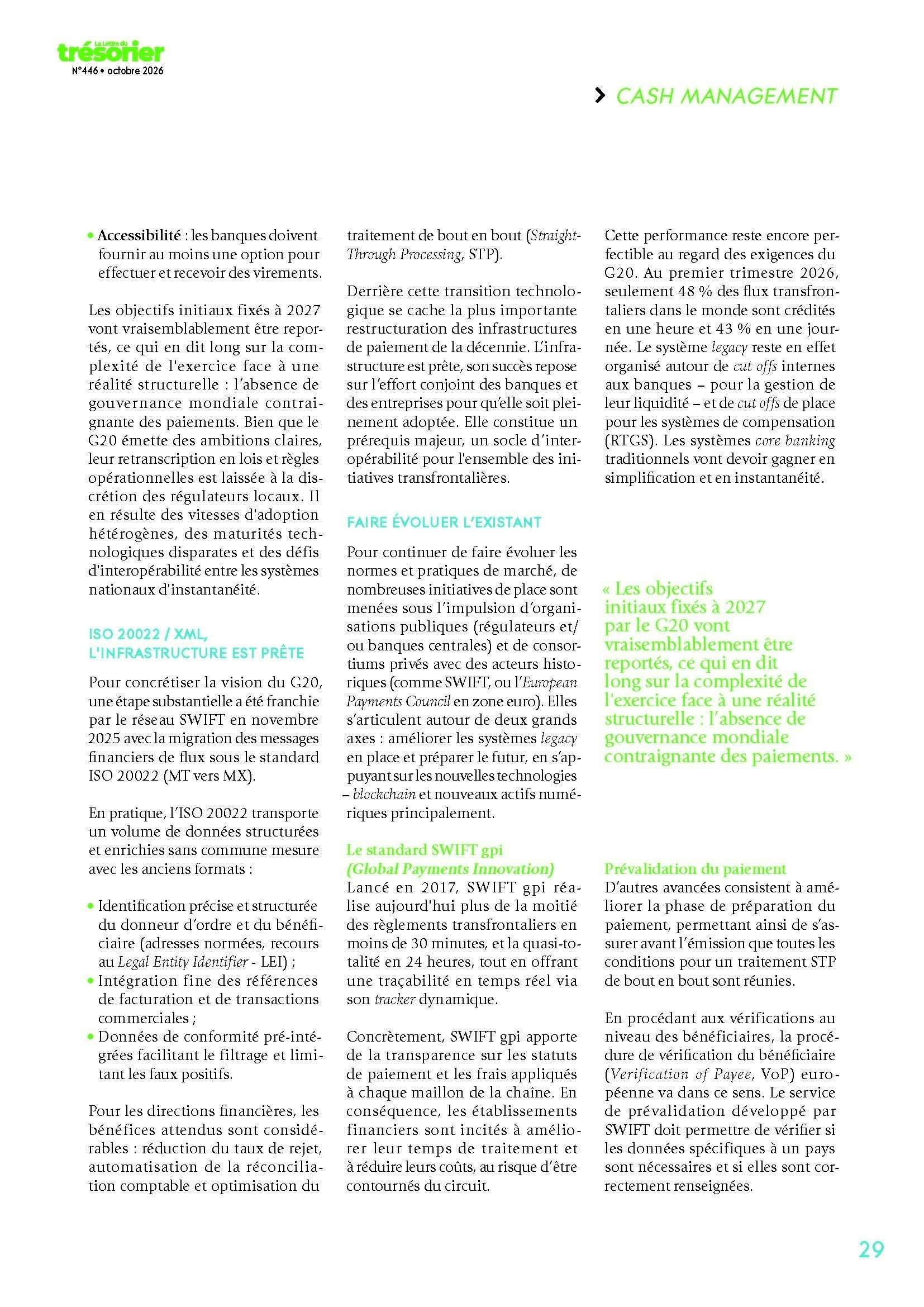
The G20 roadmap: achievable?
Addressing this situation, the G20 mandated the Financial Stability Board (FSB) and the Committee on Payments and Market Infrastructures (CPMI) in 2020 to oversee the improvement of cross-border payments around four pillars:
- Speed: transitioning to settlement within seconds or minutes;
- Cost: reducing the average cost of international transfers
- Transparency: real-time traceability and immediate clarity on fees;
- Accessibility: banks must provide, and clients must have, at least one option for sending and receiving transfers.
The initial targets set for 2027 are unlikely to be met, which reveal much about the complexity of the task when faced with a structural reality: the lack of binding global governance for payments. Although the G20 sets out clear ambitions, translating them into laws and operational rules is left to the discretion of local regulators. This results in uneven adoption rates, disparate technological maturity, and interoperability challenges between domestic instant payment systems.
ISO 20022/XML: infrastructure is ready
To turn the G20's vision into reality, a substantial step was taken by the SWIFT network in March 2023 then in November 2025 with the migration of financial flow messages to the ISO 20022 standards (MT to MX).
In practice, ISO 20022 carries a volume of structured and enriched data that is incomparable to legacy formats:
- Acurate and structured identification of the ordering and the beneficiary parties (standardized addresses, use of the Legal Entity Identifier - LEI);
- Detailed integration of billing and commercial transaction references;
- Pre-filled compliance data facilitating screening and limiting false positives.
For corporate treasury departments, the expected benefits are substantial: optimized straight-through processing (STP), reduced rejection rates and automated accounting reconciliation).
Behind this technological transition lies the most significant transformation of payment infrastructures of the decade. The infrastructure is ready; its success depends on the joint effort of banks and corporates to ensure its full adoption and implementation. It constitutes a major prerequisite, an interoperability foundation for all cross-border initiatives.
Initiatives focus on upgrading legacy systems and practices while leveraging new technologies, primarily blockchain and new digital assets. This brings seamless client journey and sovereignty to the forefront.

Huyen de Gouttes
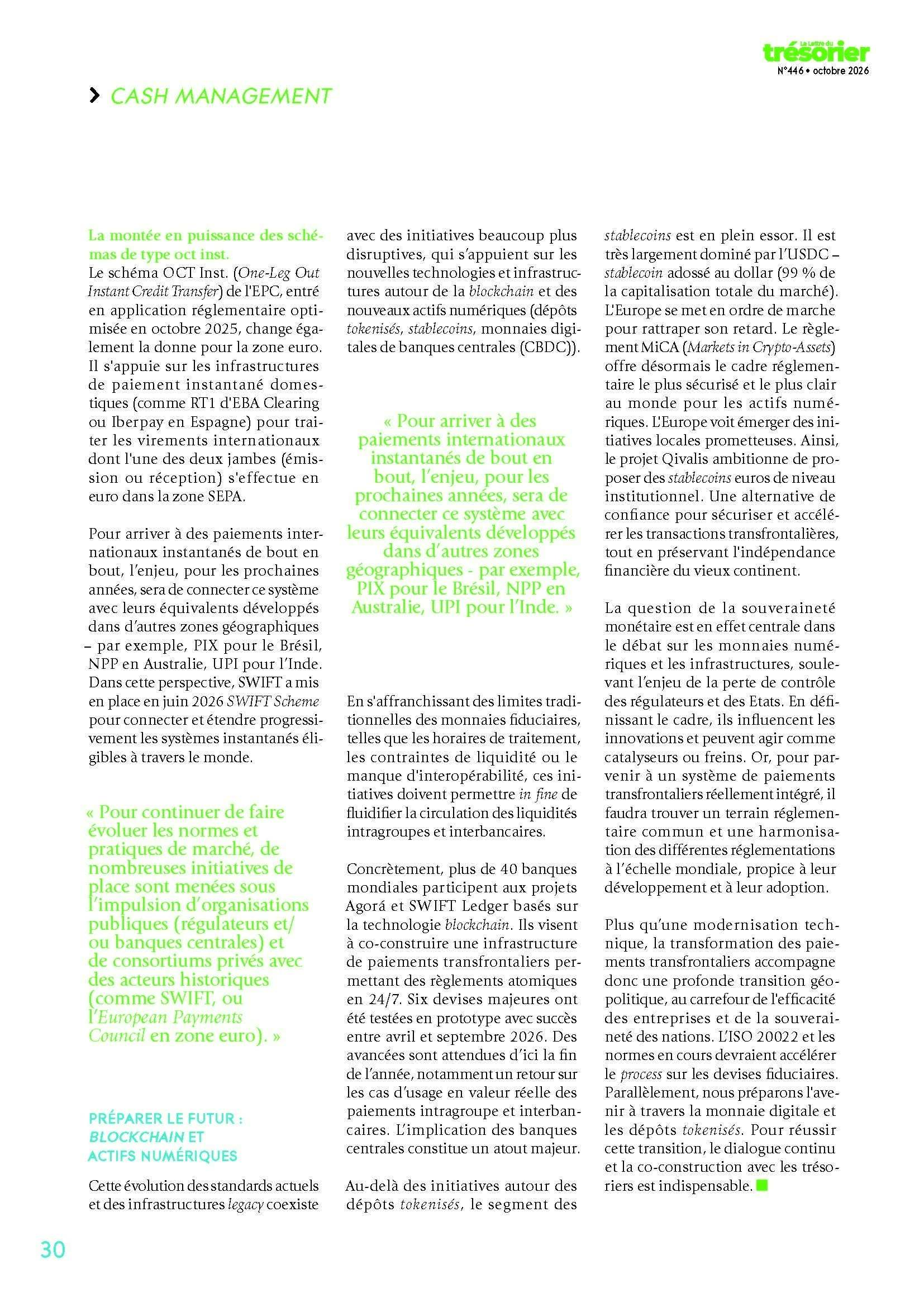
Upgrading legacy systems
To keep driving the evolution of market standards and practices, numerous market initiatives are being conducted under the impetus of public organizations (regulators and/or central banks) and private consortia with key industry players (such as SWIFT, or the European Payment Council EPC in the Eurozone).
These initiatives focus on two main areas: upgrading existing legacy systems; and preparing for the future, by leveraging new technologies - primarily blockchain and new digital assets.
The evolution of Swift GPI
Launched in 2017, Swift GPI (Global Payments Innovation) now records over half of cross-border payments in under 30 minutes, and almost within 24 hours, while offering real-time traceability via its dynamic Tracker.
In practice, Swift GPI brings transparency to payment status and fees applied at each stage of the chain. Consequently, financial institutions are incentivized to improve their processing times and to reduce their costs, or risk being bypassed in the payment routing chains.
This performance still leaves room for improvement in light of G20 requirements. As of Q1 2026, 91% of global cross-border flows are credited within 1 day. Indeed, the legacy system remains strongly dependent upon internal bank cut-off - for liquidity management purposes - and market cut-offs for clearing systems (RTGS). Traditional core banking systems will need to become more flexible and instant.
Payment pre-validation
Other industry moves focus on improving the payment preparation, thereby ensuring before execution that all requirements for end-to-end STP processing are met.
By performing checks at the beneficiary level, the European Verification of Payees (VoP) aligns with this objective. The pre-validation service developed by SWIFT is designed to verify whether country-specific data is required and if it has been correctly completed.
The rise of OCT Inst. schemes
The EPC's OCT Inst. (One-Leg Out Instant Credit Transfer) scheme, which entered into regulatory application in October 2025, is also a game-changer for the Eurozone. It leverages domestic instant payment infrastructures (such as EBA Clearing's RT1 or Spain's Iberpay) to process international transfers where one of the two legs (issuing or receiving) takes place in euro within the SEPA zone.
To achieve end-to-end instant international payments, the challenge in the coming years will be to connect the cross border legs into this domestic system and the equivalents developed in other geographical areas - for instance, PIX in Brazil, NPP in Australia, and UPI in India. For this purpose, SWIFT launched the SWIFT Scheme in June 2026 to connect with cross border flows and gradually extend eligible instant systems worldwide upon a standardized Service Level Agreement.
Preparing for the future: blockchain and digital assets
This evolution of current standards and legacy infrastructures coexists with more highly disruptive initiatives, which leverage new technologies and infrastructures based on the blockchain and new digital assets (tokenized deposits, stablecoins, central bank digital currencies (CBDCs)).
By overcoming the traditional limitations of fiat currencies, such as processing hours, liquidity constraints, these initiatives are ultimately designed to facilitate the large payment flows of intragroup and interbank liquidity.
Blockchain: the essential tech
In concrete terms, more than 40 global banks are participating in the Agorá and SWIFT Ledger projects based on blockchain technology. They aim to co-create cross-border payment infrastructures enabling atomic settlements on a 24/7 basis. Six major currencies were successfully tested in prototypes between April and September 2026.
Further progress is expected by the end of the year, notably a finetuning on real-value use cases for intragroup and interbank payments. The involvement of central banks will represent a major asset.
Sovereignty in the balance: Europe’s stablecoin push
Beyond initiatives leveraging tokenized deposits on bank balance sheet, the stablecoin asset class is booming, largely dominated by dollar-backed stablecoin - USDC/USDT represent 99% of total market capitalization.
Europe is getting into gear to catch up. As the MiCA (Markets in Crypto-Assets) regulation now offers the most secure and clearest regulatory framework in the world for digital assets, Europe is seeing the emergence of promising initiatives. For instance, the Qivalis consortium supported by 37 largest European banks aims to offer institutional-grade euro stablecoins. A trusted alternative to secure and accelerate cross-border transactions
The question of monetary sovereignty is indeed central to the debate on digital currencies and infrastructures, raising the issue of losing control for regulators and states. By defining the framework, they influence innovations and can act as catalysts or barriers.
However, to achieve a truly integrated cross-border payments system, it will be necessary to find common ground, a harmonization of different regulations on a global scale will facilitate their development and adoption.
More than a technical modernization, the transformation of cross-border payments thus accompanies a profound geopolitical transition, at the crossroads of corporate efficiency and national sovereignty. ISO 20022 and ongoing standards should accelerate the process for fiat currencies.
At the same time, we are preparing for the future through digital currency and tokenized deposits.
To succeed in this transition, continuous dialogue and co-creation with our corporate treasury clients is essential.